What happens when traditions depend on hands that are slowly disappearing?
There was a time when a woven cloth did not need explanation. It simply existed as part of life. It was worn to mark adulthood, folded carefully for marriage exchanges, or carried quietly through ceremonies that bound families and communities together. A piece of tenun was never just owned, it belonged within a lineage.
Today, encountering a finely tenun often feels different. Not rarer in appearance, perhaps, but rarer in origin. Behind each textile lies a reality few see: fewer women learning the loom, fewer households continuing the practice, and fewer reasons for younger generations to remain within traditions that no longer promise stability. The question surrounding tenun is no longer whether people admire it. The question is whether enough hands will continue to make it.
Across Indonesia, tenun stands apart from other textiles because it functions not merely as decoration, but as a form of knowledge. Every motif records relationships between people, land, spirituality, and memory. This role is especially evident in eastern Indonesia, including the Tanimbar Islands, where weaving once formed part of social identity itself.
A woman learned to weave not through formal instruction but through proximity, observing mothers and grandmothers at work until movement became instinct. Cloth circulated through kinship systems, it was inherited, exchanged, and lived with daily.
That continuity, however, has begun to loosen. Younger generations increasingly leave villages in pursuit of education or urban employment, decisions shaped less by rejection of tradition than by economic reality. Weaving requires patience measured in months, physical endurance, and attention that resists interruption. Yet the financial return rarely matches the labour invested. Tradition remains emotionally valued, but increasingly difficult to sustain as livelihood.
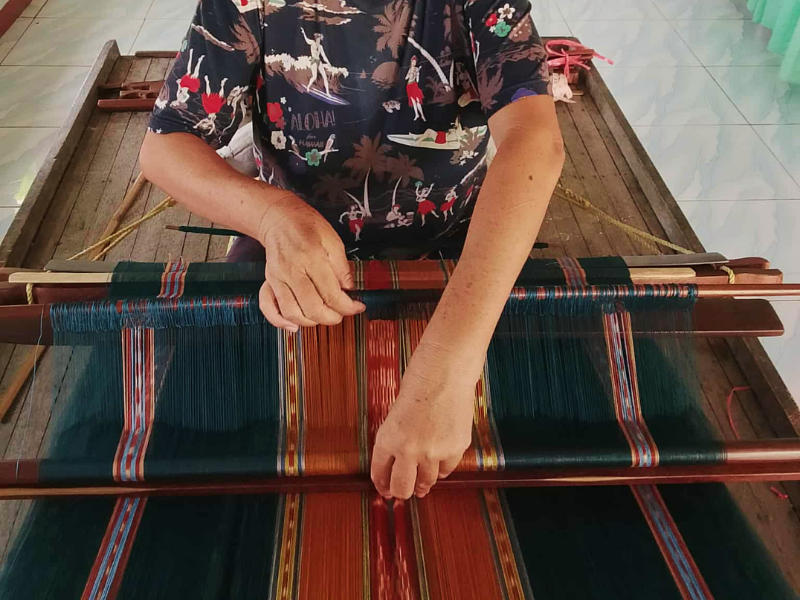
What disappears is not culture overnight, but transmission itself. Motifs remain documented long after the number of skilled weavers declines.
At the same time, handmade textiles now enter markets governed by speed and affordability. Industrial fabrics arrive faster and cheaper, while tenun follows rhythms determined by natural dyes, manual looms, and human concentration. Cultural appreciation persists, yet support often stops at admiration. Many textiles eventually migrate into collections, exhibitions, or ceremonial wardrobes, respected yet detached from everyday life.
Tradition survives, but at a distance. It is within this fragile space that Lamerenan quietly emerged. Founded by Hiyashinta Klise, the initiative began not with a business plan but with a family concern. Within her own lineage, weaving knowledge was nearing its end. Her grandmother remained the last active weaver, followed by only one younger relative capable of continuing the craft. The possibility that Tanimbar weaving might disappear was no longer abstract.
“Lamerenan actually started as a family-driven initiative,” Shinta recalls. “At that time, the last active weaver in our family was my grandmother. We realised the tradition could simply stop with our generation.” What began as an effort to reconnect with heritage gradually evolved into a broader cultural practice.
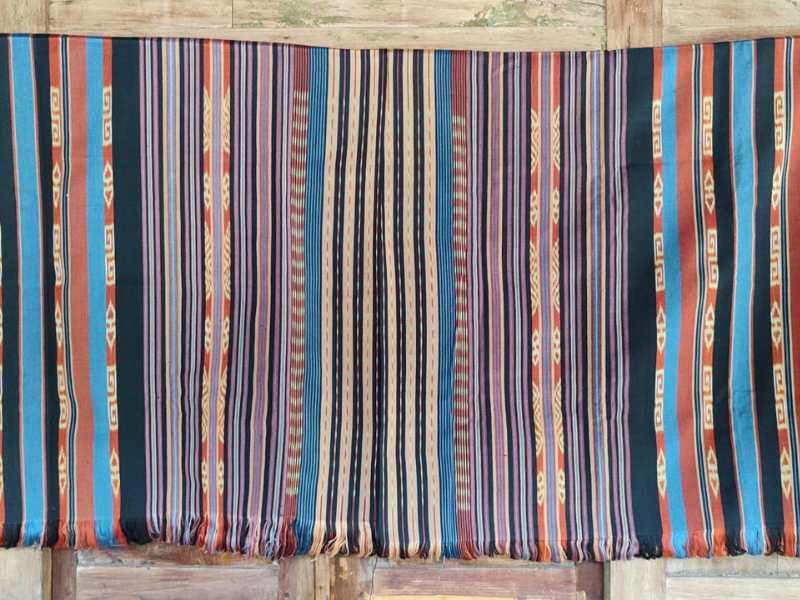
Early attempts focused on reintroducing Tenun Tanimbar to audiences unfamiliar with it, translating ceremonial textiles into functional objects such as woven ties without disrupting the integrity of traditional motifs. Adaptation became a way for tradition to move, rather than remain preserved in stillness.
For Lamerenan, tradition is understood not merely as inheritance but as guidance. “Tradition is a container of knowledge,” Shinta explains. “Inside it are teachings about how we relate to nature, to God, and to one another.” The weaving process itself, slow and repetitive, becomes part of that philosophy, encouraging attentiveness rarely afforded in contemporary production systems.
Within these modern demands, the brand operates through collaboration across geography. Yarn sourced from Java is sent to artisans in Tanimbar, where textiles are woven using traditional methods before returning to Jakarta for distribution. Natural fibres and plant-based dyes remain central, while design direction respects ancestral patterns rather than reshaping them for trend cycles. Modern relevance is achieved carefully, ensuring motifs remain whole and culturally legible.
The challenge, however, extends beyond design. Distance, infrastructure limitations, and communication barriers remain constant realities when working with remote weaving communities. Rather than accelerating production, Lamerenan expands participation by involving more artisans, allowing growth without forcing the craft beyond its natural rhythm.
This approach responds directly to one of the most persistent misunderstandings surrounding handmade textiles. How people often think tenun is simply expensive. Shinta notes. “What they don’t see is the time and skill behind each piece.” Value, in this context, reflects labour accumulated quietly over generations.
Signs of renewal are beginning to appear. Younger audiences increasingly encounter tenun through seminars and cultural discussions, some approaching it as part of contemporary art discourse. Interest grows, even if purchasing power and local engagement continue to pose challenges.
Preservation, it seems, remains an ongoing negotiation rather than a completed achievement. Tenun is not disappearing because people have stopped caring. It disappears when care no longer sustains livelihoods.
What Lamerenan demonstrates is that tradition survives when it is allowed to remain useful, lived, and economically meaningful. By reconnecting artisanship with modern life while maintaining cultural authorship, the initiative restores weaving as practice rather than memory.
Where tradition weaves, continuity becomes possible, not through nostalgia, but through hands still willing, and able, to continue the work.