In the hills above Waikabubak stands Prai Ijing, a traditional village where ancestral traditions continue to shape everyday life, sustained across generations. Set along a ridge overlooking West Sumba Regency, Prai Ijing emerges gradually within the landscape, its towering thatched roofs rising in rhythmic formation against wide skies and rolling savanna terrain.
The journey toward Prai Ijing begins long before the village itself comes into view. From Tambolaka Airport, the primary gateway to western Sumba, the road unfolds across undulating hills streaked with dry grasslands and grazing horses. Villages appear intermittently along the route, marked by traditional houses standing quietly against vast horizons. As the drive approaches Waikabubak, the terrain begins to climb, narrowing into winding roads that trace the contours of the hills before finally revealing Prai Ijing resting along a ridge line.
Arrival is unhurried. The village does not announce itself abruptly, instead, it reveals its presence through atmosphere. Rows of ancestral houses stand facing one another across a long stone courtyard, forming a settlement that feels both ceremonial and lived-in. The air carries the scent of earth and woodsmoke, while daily rhythms continue with gentle indifference to travelers' arrival.
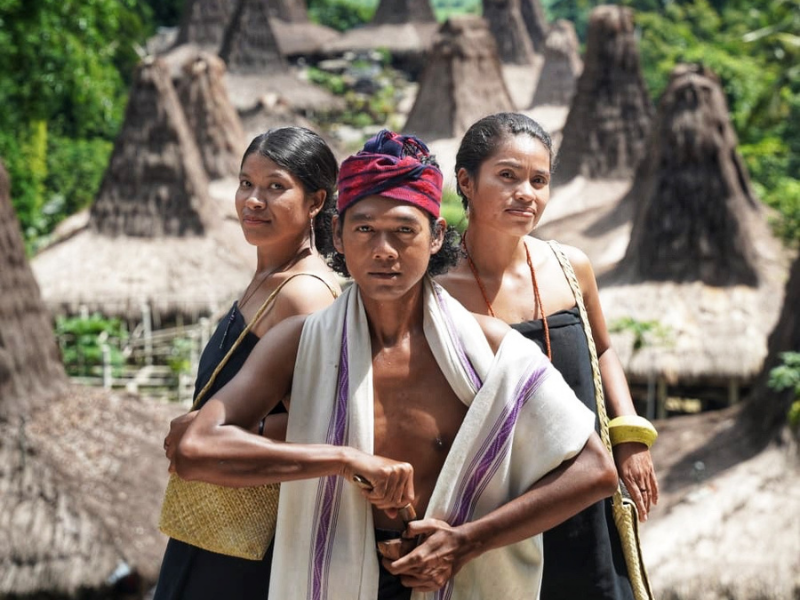
Guests are often received through gestures of traditional hospitality, where movements, music, and dance offer an introduction to Sumbanese cultural expression. Performances such as Woleka, Pajura, and Kataga unfold not as staged attractions but as extensions of communal welcome, bridging strangers and hosts through inherited custom. The reception sets the tone for what follows: an encounter shaped less by observation than participation.
Moving deeper into Prai Ijing, it reveals the structure of a community shaped collectively across generations. Around thirty traditional houses stand along the central courtyard, inhabited by seven ancestral clans whose lineage continues to define social life. Each house rises vertically with great precision, its layered thatched roof stretching skyward while grounding the settlement firmly within its landscape.
Architecture here reflects a cosmological order shared throughout West Sumba. The lowest level connects directly to nature, sheltering livestock and storing harvests essential to daily survival. Above it lies the domestic living space, where meals are prepared, stories exchanged, and families gather at dusk. The uppermost chamber remains sacred, safeguarding heirlooms and spiritual objects entrusted to ancestral protection. Every structural element expresses an understanding that life exists between earth, humanity, and the spiritual realm.
At the heart of the village lie megalithic stone tombs, positioned not apart from homes but among them. Ancestors remain present within everyday life, their graves forming silent centres around which conversations unfold, children play, and communal work continues. Placement within the village follows customary laws preserved by elders, ensuring that spatial harmony reflects social balance.
Underlying these rhythms is Marapu, the indigenous belief system that continues to guide spiritual and society existence. Agricultural cycles, ceremonies, and responsibilities follow ancestral teachings passed down through generations. Tradition is encountered not only during ritual occasions but in ordinary moments: textiles woven beneath raised houses, elders sharing stories near stone monuments, and neighbours working collectively through daily tasks.
Certain times of the year bring heightened cultural intensity, particularly during Wulla Poddu, the sacred month dedicated to ancestral reverence and spiritual reflection. The resonance of gongs and drums fills the courtyard, ritual chants echo across the hills, and communal ceremonies reaffirm relationships between the living and those who came before. During these periods, Prai Ijing reveals itself unmistakably as a living cultural landscape rather than a preserved relic.
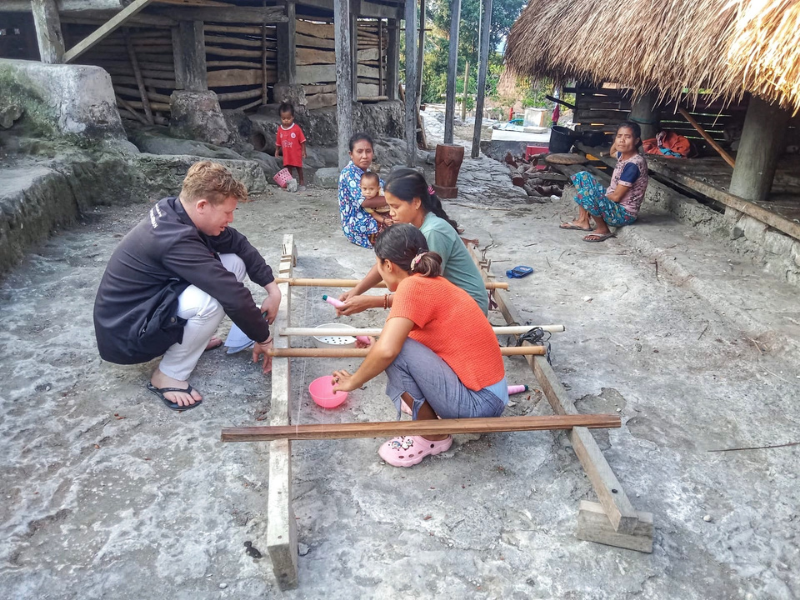
As daylight softens, the village atmosphere shifts. Evening arrives quietly over the ridge, casting long shadows across stone paths while smoke rises from kitchen fires. Spending the night in Prai Ijing allows travelers to experience the village beyond daytime curiosity. Conversations slow, stars emerge unobstructed by clear light, and the sounds of nature replace the movement of travel. The stillness reveals the deeper cadence of life sustained here, measured, communal, and enduring.
Morning here begins early. Roosters call across the courtyard as sunlight gradually illuminates the towering roofs, revealing once again the intricate relationship between architecture, belief, and environment. From the surrounding hills, views extend toward landscapes that define West Sumba’s character, including nearby highlands and distant coastal horizons bordering the Indian Ocean. Yet the essence of the journey remains within the village itself, where heritage continues not as performance but as lived reality.
Visits to Prai Ijing are best arranged through @pokdarwis.praiijing, the community-based tourism group that serves as the primary bridge between visitors and local residents. Their initiatives facilitate guided access, cultural experiences, accommodation arrangements, and responsible travel practices, ensuring that tourism directly supports local livelihoods while preserving cultural integrity.
More than a destination, Prai Ijing represents continuity, a village where tradition is neither reconstructed nor remembered from afar, but carried forward through everyday life, standing resilient upon the hills of Sumba.