Some materials find their masters long before a single blueprint is ever drawn. For Richie Pratadaja, chocolate has always held that kind of pull. His world is one where it is treated not simply as an ingredient, but as a living medium, moving between sweetness and depth, creativity and play. After leaving design school for the life of the kitchen, he committed himself to years of intensive practice, shaping a craft built on patience, precision, and continual learning.
Today, his work reflects a mastery formed through experience. Creations that balance experience, structure, technique and intuition. More than anything, his approach is rooted in the simple pleasure of sharing something made with care, where chocolate becomes a meeting point between people, culture, and the everyday rituals that bring them together.
“Chocolate doesn’t have to live inside fixed ideas. It can meet local ingredients, everyday memories, and habits we recognise. That freedom, to let chocolate move beyond its usual frame, is what excites me the most.”
[TPB] What first drew you to chocolate, and when did it shift from curiosity into a lifelong calling?
I began my culinary journey in 2009, after stepping away from my previous focus and realising I wanted to work with something more interesting. I enrolled in culinary school, Le Cordon Bleu College of Culinary Arts in Scottsdale, Arizona without a fixed direction, until I volunteered as an assistant in a chocolate masterclass. In the space of five days, something clicked. I discovered how chocolate could move between states, fluid and solid, delicate and structural, and how one ingredient could become both dessert and centrepiece. Before I graduated, I already knew I wanted to be a chocolatier.
After school, I joined the Bellagio in Las Vegas. I did not start with chocolate straight away. I worked across banquets and pastry sections, learning the rhythm of professional kitchens. When my chef saw my interest, he moved me into the chocolate area, where I trained closely. That period shaped my foundations and confirmed that this was the path I wanted to follow.
Not long after, a short visit to New York changed my plans entirely. I was drawn to the energy of the city and decided to move, even without a position waiting. I ended up spending ten years there, gaining experience, perspective, and a deeper understanding of the craft.
In 2019, I returned to Indonesia, just as the local culinary scene was entering a new chapter. Sixteen years on, I am still here. It is a demanding industry, but it is also the one that continues to hold my curiosity, discipline, and love for the work.
[TPB] What makes the Indonesian chocolate and pastry scene uniquely interesting compared to what you experienced overseas, and what led you to open your own place?
When I returned to Indonesia, opening a chocolate-focused space was not an obvious choice. At the time, chocolate here was still largely seen as something casual, enjoyed quickly, not yet approached with the same curiosity or ritual found in parts of Europe or the United States. Many friends told me it would not last. But chocolate is what I understand, and what I wanted to contribute. I knew I was not here to follow trends, but to help build a culture.
What makes the Indonesian scene especially interesting to me is the way people consume food here, and the openness to flavour. There is a strong everyday food culture, and with it, a freedom to experiment. Chocolate does not have to stay within rigid boundaries. It can meet ingredients, memories, and habits that are deeply local, sometimes unexpected. That possibility, to let chocolate move beyond its usual frame, is something I find very exciting.
Opening my own place became a way to start that conversation. It was about creating a space where chocolate could be explored with care, but also with play. Six years on, I can see real movement. The pastry and chocolate scene has grown and there is a stronger appetite for craft. It is still developing, but that is what makes it alive. You can feel the energy of something in progress.
[TPB] What is challenging for you in this culinary scene?
There are many challenges, and they start long before the kitchen. One of the ongoing ones is understanding, introducing people to what good chocolate really is, and helping them understand the difference between something made for convenience and something made with care. In Indonesia, chocolate is still a small, specialised world. Choosing to focus on chocolate means working in a space that is still being built.
Labour is another reality. Chocolate requires precision, patience, and people who are willing to grow with the craft. That combination is not easy to find, and even harder to sustain. Beyond the technical side, there was also the personal challenge of coming home. After more than a decade away, I returned to a city that had changed completely. I had to relearn the rhythm, the industry, and the way people connect with food.
In the early days, the difficulty was largely cultural. Chocolate was often measured by price, not by process. I learned to respect that perspective while staying grounded on my own. Now, I am less concerned with comparison and more focused on contribution. The scene is growing. There is movement, curiosity, and new energy. Being part of that shift, and growing alongside it, is what keeps me motivated.
[TPB] With all of that, and in Indonesia where we are rich in flavour and culture. How do those elements influence the way you build your creations?
Experience and development work sit at the foundation of everything I make. That process is essential. But living in Indonesia has added an entirely new layer. I’m constantly drawn to local ingredients, especially the ones people don’t usually associate with chocolate. When I encounter something unfamiliar, my instinct is to explore it, to see how far it can be taken.
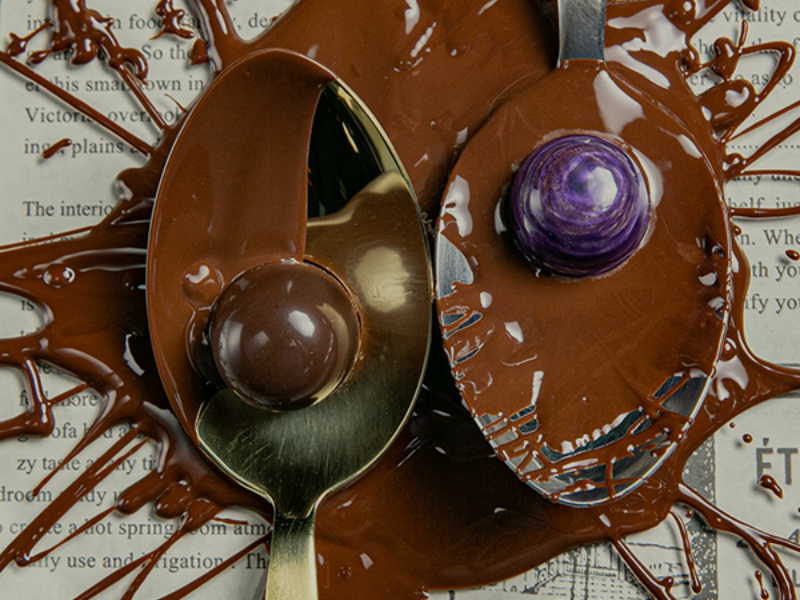
One example is Kluwek, an ingredient more commonly found in savoury dishes like Rawon. It’s naturally poisonous and only becomes edible through careful preparation. That quality fascinated me. I translated it into a bonbon called Ivy.
Then comes the development process that always begins with understanding the ingredient itself: its profile, its behaviour, and how different techniques can reshape it. I taste first, then experiment with multiple methods of processing, before deciding which expression feels right. From there, attention turns to structure. For me, a piece has to work across flavour, mouthfeel, form, and presentation.
Nothing arrives fully formed. I work closely with the team, testing, revising, and refining. Sometimes a concept takes weeks to resolve. Sometimes less. It depends on the ingredient and what it demands. But the intention is always the same, to build something that feels considered, balanced, and open to discovery.
[TPB] Is there a particular creation that best represents who you are today as a chocolatier?
I think all of them can represent me, because the work is always evolving. What we make today won’t be the same in a few months, or even a few years. That constant movement is part of who I am.
Even the name of my place, Criollo, comes from the idea of creation. It reflects how I work, and how I want the team to work too. I give them space to develop their own ideas, as long as they meet our standards in ingredients and execution. If something stands up to that, we stand behind it. For me, that freedom is essential, not only for the product, but for building confidence within the kitchen.
And here, personally, I’ve never been interested in reproducing what’s already everywhere. Trends come and go, and it’s easy to follow them. But that isn’t what drives us. I’d rather spend that energy developing something new, something that belongs to our language of flavour, instead of chasing what happens to be viral at the moment.
[TPB] What recent trends or innovations in chocolate are you excited about?
What interests me most right now is how the industry is responding to change. With cacao supply under pressure and demand continuing to rise, many chefs and food technologists are beginning to explore alternatives, products that resemble chocolate, but are built from different bases, often with a focus on lower sugar and new nutritional values. It’s a direction that will only grow in the coming years.
At the same time, my own excitement still lives in working more thoughtfully with what we already have. At Criollo, we don’t rely on added sugar, and we pay close attention to every component that goes into our work. For me, the future isn’t only about replacing chocolate, but about understanding it more deeply, refining how we treat flavour, balance, and the ingredients themselves.
[TPB] What’s coming up this February that you’d like to share with us?
This year marks a period of expansion for us. Alongside, I really want to develop more desserts that explore vegetables and savoury elements, also preparing a new four-storey space in Central Jakarta. It’s conceived as a layered destination, pastry and savoury on the ground floor, a bar above it, a function hall for gatherings, and a semi-rooftop level designed to be open, relaxed. And our place will be absolutely pet-friendly. It’s a project that reflects where we are now, and where we hope to take the brand next.
For February specifically, we’re shaping a few seasonal moments. For Chinese New Year, we’ll be introducing a curated hamper that brings together savoury elements and pastry, with orange-led creations as a nod to the season. Valentine’s will follow with a set-menu dinner, alongside special plated desserts and a selection of new chocolate bonbons.