Batik in Indonesia is often associated with deep earth tones, symbolic patterns, and traditions shaped within royal courts. For centuries, these restrained palettes carried social meaning, marking status, ceremony, and heritage. This visual narrative became the main face of batik, shaping how the cloth was remembered and worn.
Yet beyond the palace walls, another expression quietly flourished. In port cities shaped by migration and trade, batik absorbed daily encounters between cultures. Soft pinks drawn from porcelain florals, mint greens, lavender hues, turquoise washes, and cream grounds, colours enriched by culture, began to define a different textile language.
This was Batik Peranakan.
Rather than emerging from ritual, it grew from domestic life. Worn within families, gifted between generations, and crafted inside multicultural communities, Batik Peranakan carried intimacy alongside ornamentation. Its motifs blended Chinese, European, Japanese, and Indonesian influences, creating cloth that felt expressive rather than restrained, decorative yet deeply personal.
What distinguished Batik Peranakan was not only its history, but its emotional tone. The softness of its colours invited closeness. The harmony of its motifs reflected coexistence rather than hierarchy. It was batik designed to live with people, not to stand apart from them.
Long before contemporary fashion celebrated versatility and wearability, Batik Peranakan had already embodied both. Its palettes feel naturally modern, its visual lightness aligns seamlessly with today’s lifestyle aesthetics, and its decorative balance allows the cloth to be styled rather than preserved. In this harmony of colour, culture, and everyday life lies the enduring relevance of Batik Peranakan, a heritage that feels gentle yet powerful, historical yet unmistakably current.
For decades, however, Batik Peranakan remained less visible within mainstream batik narratives. It was often simplified, mislabelled, or absorbed into broader regional categories. In some circles, it was viewed merely as “Chinese-style batik,” while in others, its intricate motifs led to the assumption that it must be printed rather than hand-drawn.
As Puteri Widia, founder and creative director of Karatungga, explains, “Batik Peranakan is often misunderstood as just a local batik style, or purely Chinese in influence. In reality, it carries layered stories of Japan, Europe, China, and Indonesia within a single cloth.”
This quiet marginalisation meant that Batik Peranakan, despite its historical richness, rarely occupied the centre of contemporary fashion conversations. Yet its visual language feels strikingly modern. The pastel tones that once reflected porcelain ceramics now align naturally with today’s aesthetic sensibilities. The motifs, decorative yet balanced, invite styling rather than preservation. Unlike batik that leans toward formality, Batik Peranakan carries an intimacy that feels lived-in, handcrafted and designed for daily beauty.
It is within this renewed relevance that Karatungga finds its purpose. This brand officially began in 2022, born not from trend forecasting but from a growing cultural restlessness. Before founding the brand, Puteri Widia did the research into galleries, conversations with textile scholars, and eventually into a year-long research journey across batik-producing cities such as Pekalongan, Lasem, Cirebon, and Kulon Progo. It was in these colours that became the emotional core of Karatungga.
The brand positions itself as a bridge between heritage and daily life, reintroducing Batik Peranakan not as an artifact, but as fabric meant to move with modern routines. Each batik tulis becomes a visual dialogue of cultures: Japanese floral influences merge with Chinese symbolism, European ornamental rhythms blend into Indonesian structures. Within a single length of fabric, multiple histories coexist: not competing, but harmonising.
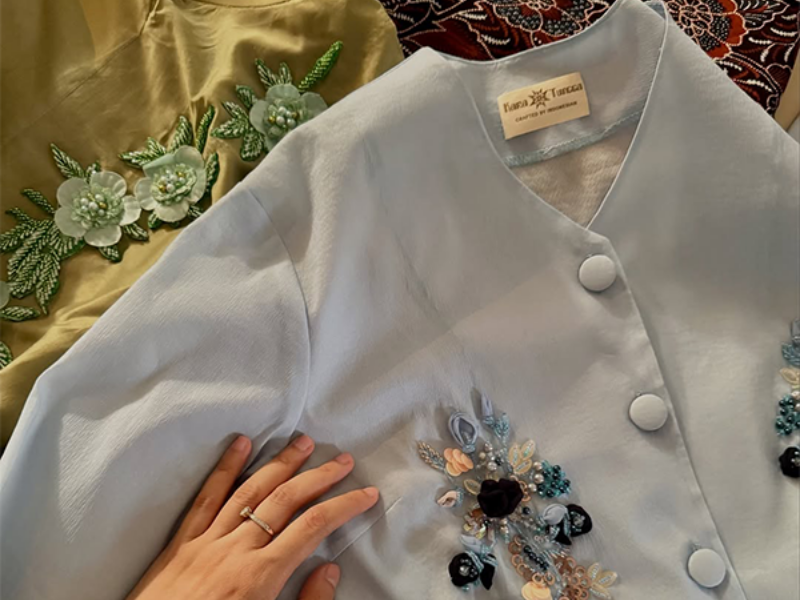
This philosophy extends beyond design into process. Karatungga works primarily with hand-drawn batik on natural fibres such as cotton and silk. Artisans produce from their own homes, allowing traditional skills to remain part of everyday life rather than factory systems. Finished fabrics move through careful colouring stages, preserving the slow rhythm that defines hand-drawn batik.
In an industry driven by speed and instant consumption, such slowness becomes a quiet form of resistance. Consistency remains one of the brand’s greatest challenges. Sustaining heritage craftsmanship while educating a fast-moving market requires continuous dialogue. Yet it is precisely this persistence that allows Batik Peranakan to remain alive rather than archived.
As Karatungga evolves, its commitment to harmony expands into modern silhouettes. While batik tulis remains its heart, the brand now explores ready-to-wear collections designed for contemporary wardrobes. The latest release, Adi Kirana, introduces soft purple tones and embroidery, drawing inspiration from cheongsam structures and baju kurung silhouettes, translated through Karatungga’s pastel identity.
The result is clothing that feels rooted yet fluid, respectful yet current. This is where Batik Peranakan fully steps into modern life. Beyond aesthetics, the emotional intention remains central. Karatungga’s language aims to make batik feel joyful, approachable, and personal, pieces meant to accompany daily rhythms rather than remain reserved for special occasions.
Wearing Karatungga is designed to carry story, time, and quiet happiness. In a broader cultural landscape where heritage often struggles to compete with trends, Batik Peranakan offers harmony rather than hierarchy, softness rather than severity, and coexistence rather than purity.
Karatungga stands as a living expression of Batik Peranakan’s relevance today. It demonstrates how heritage can evolve without losing integrity, how tradition can feel modern without dilution, and how cultural complexity can become everyday beauty. As new collections continue to unfold, Karatungga invites deeper engagement with Batik Peranakan as a lived experience. And it finds a home. A place where heritage breathes softly into modern life, inviting appreciation not through spectacle, but through intimacy, beauty, and balance.