Sustainability has quietly transformed from a niche concern into fashion’s favourite promise. It lives in muted campaign palettes, eco-conscious hangtags, and collections marketed as kinder to the planet. The shift itself signals progress, a long-overdue awareness in an industry built on excess. Yet as the word grows louder, its meaning often becomes thinner, flattened into aesthetic gestures rather than lived responsibility.
And this concept in fashion isn’t just replacing one fabric with another or introducing a single conscious line each season. It exists in the invisible layers, in how materials are sourced, how frequently collections are produced, how artisans are treated, and how nature is allowed to recover between cycles of production. Without these elements moving together, sustainability risks becoming performance rather than practice.
This balance sits at the core of Indonesia’s textile traditions. Long before “sustainability” entered the modern lexicon, batik communities existed in a quiet, seasonal dialogue with the land. Pigments were yielded by the earth, motifs were etched with ancestral meaning, and the pace of creation was governed by patience rather than the rush of demand. Here, fashion is not a product of mass output, but a living reciprocity between the artisan, the craft, and the environment.
As contemporary fashion accelerates, many of these rhythms have been disrupted, yet they have not disappeared. Across local industries, a new generation of creators is returning to these principles, as a necessary response to environmental strain and cultural erosion. Sustainability becomes less about innovation alone and more about remembering what balance once looked like.
Today, the revival of sustainable fashion within local industries represents not only environmental awareness, but a return to values that once shaped Indonesian craftsmanship itself. It is within this renewed consciousness that Abhati Studio quietly grows. Founded by Putri Anggita, the studio emerged from a lifelong relationship with batik as tradition. From an early age, she understood batik as a collective ritual involving many hands and layered meanings. Each motif carried symbolism. Each colour told a story. Each fabric reflected time, patience, and community.
What began as personal familiarity grew into a responsibility: to preserve and share a practice at risk of fading amid the speed of modern fashion.
“Batik was never just about patterns,” Putri reflects. “It is a process that connects people, nature, and meaning. Every layer has its own story, and that story deserves to be honoured, not rushed.”
Abhati was built on the belief that heritage could evolve without losing its soul. Rather than replicating the past, the studio reinterprets traditional craftsmanship through contemporary silhouettes while maintaining natural processes at every stage. Sustainability is embedded not as a marketing promise, but as a working principle guiding daily decisions.
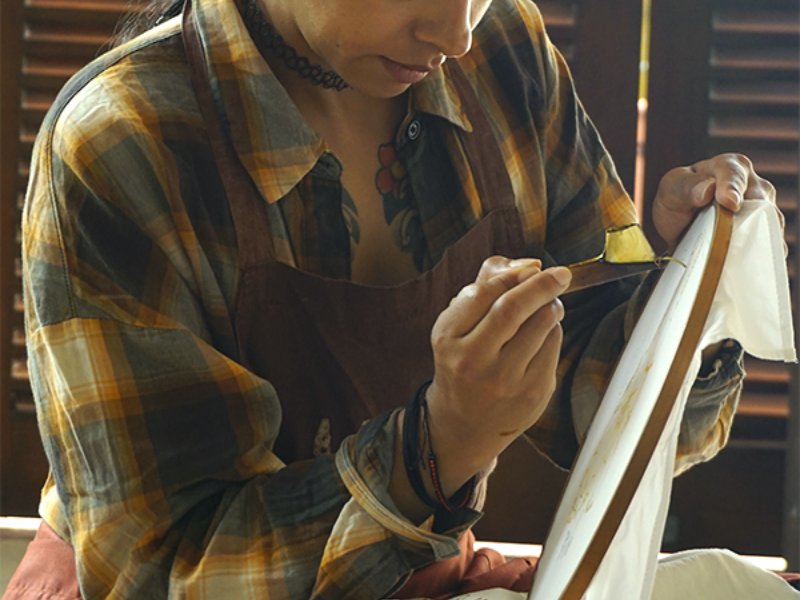
Natural dyes form the foundation of Abhati’s visual language. Indigo blue derived from Strobilanthes Cusia, warm tones from Jolawe, and earthy hues from Mangrove create colours that are organic, soft, and alive. These pigments are influenced by weather, plant maturity, and soaking time, producing subtle variations across each fabric. Rather than adjusting these differences, Abhati preserves them as nature’s signature—proof that true craftsmanship resists uniformity.
Behind every piece lies an interconnected network of farmers cultivating dye plants, artisans preparing pigments, batik makers drawing motifs by hand, dyers layering colour patiently, and tailors shaping cloth into timeless forms. Fashion here becomes a collective ecosystem rather than a singular creative output, where every contributor is valued not only for labour, but for knowledge and tradition passed down through generations.
This respect for process naturally reshapes the brand’s rhythm. Abhati’s collections emerge only when materials are ready, colours settle properly, and quality meets careful standards. Some years see only a single batch produced, a conscious choice that prioritises environmental balance over commercial pressure. “Sustainability is also about giving nature time to breathe,” Putri shares. “If the earth is not ready to give responsibly, production should pause. Creativity can continue, but extraction should not.”
Their studio in Yogyakarta opens its doors to workshops and collaborative projects, inviting visitors to experience the batik process firsthand. From preparing natural dyes to understanding the long duration behind each layer of colour, participants witness the complexity behind what often appears effortless in finished garments. Through openness, Abhati nurtures appreciation because understanding about the material, the people, the story, and the meaning for each collection feel so important for Abhati.
In an era where sustainability is frequently reduced to fabric swaps and green labels, Abhati offers a more honest, transparent model. Ethical fashion is treated as an evolving journey rather than a perfected claim. Challenges remain, particularly in educating a market still driven largely by price and instant availability. Yet through storytelling, process-sharing, and consistent practice, the brand continues to reshape how value is understood.
At its core, Abhati reflects a deeper harmony between tradition and innovation, creativity and restraint, production and preservation. It revives batik as a living, breathing craft capable of thriving within modern life without compromising its roots.
As conversations around sustainable fashion grow louder, Abhati stands as a quiet yet powerful reminder that true change rarely arrives through trends alone. It unfolds through patience, responsibility, and respect, for the earth, for craftsmanship, and for the communities that keep tradition alive.
In every naturally dyed thread and thoughtfully paced collection, Abhati Studio offers more than clothing. It offers a way of creating that listens before taking, honours before producing, and moves in rhythm rather than haste, a gentle invitation for fashion to return to harmony, one carefully crafted piece at a time.